Client
Gilead Sciences
Platforms
Web
Outcome
The redesign significantly improved content, navigation and usability, increasing doctors' satisfaction and trust in Gilead's brand and setting a new standard for digital experience in the pharmaceutical industry.

Summary
At Tribal Worldwide Health, a subsidiary of DDB and part of the Omnicom Group in London, I led user research and user experience design initiatives specifically for Gilead Sciences, a leading global pharmaceutical company. The primary goal was to enhance Gilead's digital platforms to better serve doctors and patients by aligning design solutions with their specific needs and expectations.
Understand the problem
Identifying User and Business Needs
Gilead's digital presence was fragmented and not user-friendly, making it difficult for doctors to access accurate product information quickly to find understandable content about their health conditions and treatments. Strict regulatory requirements added complexity to content presentation and navigation. There was a clear need for a unified, user-centric digital experience that catered to doctors while ensuring compliance with industry regulations.

The Solution
Information Architecture and Atomic Design Methodology
To address these challenges, I conducted user research sessions by interviewing stakeholders to understand their needs and pain points. Collaborating with a team, including healthcare professionals, provided insights into how regulatory constraints impacted user experience.
Using these insights, I developed a new information architecture and content strategy to improve usability and streamline navigation. The content was optimised for search engines to enhance discoverability, ensuring users could find information quickly.

The atomic design methodology was critical for content optimisation. Atomic design has five distinct levels: atoms, molecules, organisms, templates, and pages. It is a methodology for creating scalable systems, reusable components, and design systems.
The atomic design approach starts with the smallest of parts: the atom. In a design context, an atom refers to the most elementary aspects of a design, such as HTML tags. These HTML tags make up details in a user interface – this includes commonly used icons or UI elements like checkboxes, toggles and radio buttons. Atoms become tangible once they are grouped to form what are known as molecules. Molecules have a more understandable purpose as well as some form of functionality. An excellent example of a molecule is a search bar with a button.

When built further and joined, these molecule components form organisms. Using the search bar molecule as an example, entering a header or navigation bar at the top of the page design forms a more significant component known as an organism. The organism comprises atoms and molecules that form the building blocks of a layout. Consistency is critical to the entire website, and to ensure this, the organism can be reused across the design. I created templates by grouping multiple organisms according to Atomic Design. Illustrating the layout and relationship between the various organisms and their hierarchy is considered the template. A series of templates creates a page.
Wireframes - Component Library

Collaborative Workshops and Stakeholder Engagement
I created interactive wireframes and prototypes using Sketch and AxureRP, refining them through iterative feedback from stakeholders. This process ensured that the designs effectively met stakeholders' user needs while complying with regulatory and content requirements.

I created interactive wireframes and prototypes using Sketch and AxureRP, refining them through iterative feedback from stakeholders. Developing multiple iterations of wireframes and rapid prototypes, exploring various design solutions for content representation and navigation. This iterative process allowed for quick feedback and refinements. By testing these prototypes with users, I validated design decisions and ensured usability, ensuring the designs effectively met stakeholders' user needs while complying with regulatory and content requirements.
Design Library
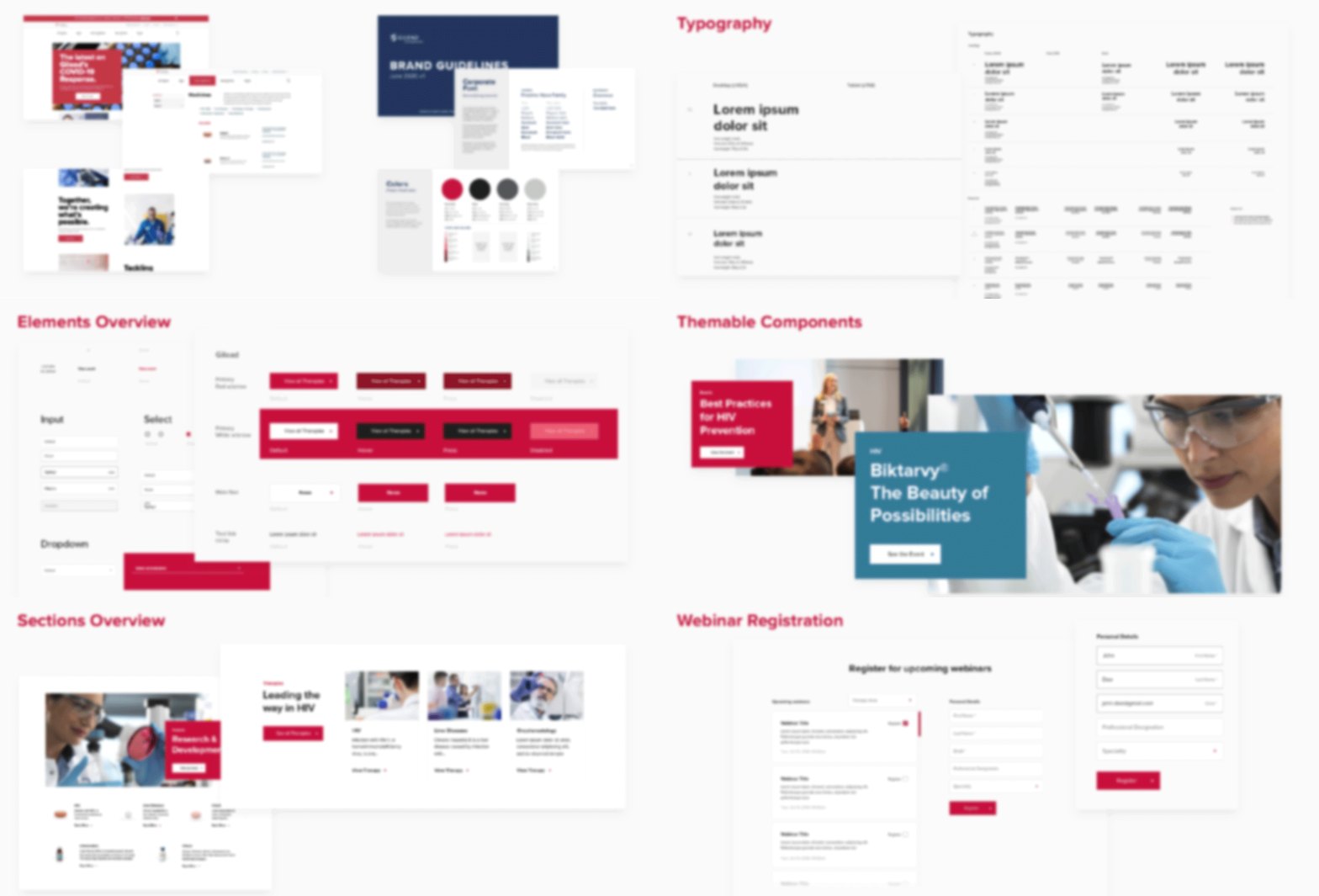
We developed a comprehensive design system based on Gilead's Brand Guidelines to maintain consistency across all screens and sites. This facilitated scalability for future growth and ensured compatibility with various Content Management Systems (CMS), making content management more efficient.
Outcomes
The redesigned website significantly improved content, navigation and usability. Doctors could access detailed product information more efficiently, making it easier to understand. Feedback showed increased satisfaction among healthcare professionals, strengthening trust in Gilead's brand.
The project successfully merged complex medical information with a user-friendly design while adhering to regulatory constraints. It set a new standard for digital user experience in the pharmaceutical industry, demonstrating how user-centred design can enhance engagement and satisfaction.


